

Table of Contents
- MDF vs Timber Skirting: Key Differences at a Glance
- What is MDF Skirting?
- What is Timber Skirting?
- Moisture Resistant MDF Skirting UK: Performance in Damp Conditions
- Cost of MDF Skirting vs Wood Skirting UK: Budget Breakdown
- Durability and Impact Resistance: Which Material Wins?
- Skirting Board Profiles UK: Design Options for Both Materials
- Fitting Skirting Boards UK: Installation and Preparation
MDF vs Timber Skirting: Pros, Cons & Cost Comparison
Last Updated: July 26, 2026
Choosing between MDF and timber skirting is one of the most practical decisions you'll make during a renovation or new build. The materials look similar once painted, but their performance, longevity, and cost differ significantly. At Univers Skirting & Architrave, we've helped thousands of homeowners and trade professionals navigate this choice. This guide covers the real-world differences in mdf vs timber skirting pros cons, so you can make a decision based on your specific situation.
MDF skirting is cheaper, more stable, and ready to paint straight away. Timber skirting offers natural aesthetics, repairability, and environmental appeal, but demands more preparation and costs considerably more upfront. Neither is universally "better", it depends on your room, budget, and long-term vision.
MDF vs Timber Skirting: Key Differences at a Glance
The fundamental difference lies in material composition and how each responds to British humidity and temperature fluctuations. MDF (medium-density fibreboard) is engineered wood made from compressed wood fibres and resin. Solid timber skirting, typically pine or hardwood, is milled directly from trees. This distinction affects everything from installation difficulty to moisture resistance to final appearance.
A bathroom renovation with cheap, unprimed MDF will likely fail within 5 years. Conversely, fitting expensive hardwood skirting in a damp Victorian terrace without proper sealing is equally wasteful. The material choice must match the room's environment and your willingness to maintain it.
Quick Comparison Table
| Aspect | MDF Skirting | Timber Skirting |
|---|---|---|
| Starting Cost | £11-£15 per metre | £10-£90+ per metre |
| Moisture Resistance | High (when primed) | Moderate (requires sealing) |
| Warping Risk | Very Low | Moderate to High |
| Installation Difficulty | Easy | Moderate |
| Repairability | Limited | Excellent |
| Paint Finish | Smooth, flawless | Requires prep work |
| Lifespan | 15-25 years | 20-50+ years |
| Best For | Bathrooms, kitchens, new builds | Period properties, stained finishes |
What is MDF Skirting?
MDF skirting boards are engineered products manufactured from wood dust and fibres bonded together with synthetic resin under heat and pressure. Most MDF skirting sold in the UK arrives primed, meaning it's already been given an initial coat of primer and is ready for topcoat paint.
The key advantage is dimensional stability. Because MDF is engineered rather than natural, it doesn't expand and contract with humidity changes the way solid wood does. This makes it ideal for British homes where moisture levels fluctuate seasonally. Moisture-resistant MDF formulations add extra resin to the core, making them suitable for kitchens and bathrooms where traditional timber would swell or rot.
Univers Skirting & Architrave manufactures premium moisture-resistant MDF skirting in profiles including Pencil Round, Ogee, Square Edge, Torus, and Bullnose. Each arrives primed and ready to paint, eliminating the sanding and undercoating step that adds time and cost on site.
What is Timber Skirting?
Solid timber skirting is milled from softwood (typically pine) or hardwood (oak, walnut, ash). The wood is kiln-dried to reduce moisture content, then machined into profiles. Unlike MDF, timber retains natural grain patterns and can be stained or varnished for a traditional aesthetic that many period properties demand.
Timber skirting's main advantage is longevity and repairability. A dent in MDF is permanent; a dent in timber can be sanded out and refinished. Over 30+ years, this repairability adds genuine value, especially in high-traffic areas or homes with children and pets.
The trade-off is instability. Solid wood moves with humidity. In winter, central heating dries homes; in summer and autumn, moisture causes expansion. This wood movement causes gaps at joints, splits along the grain, or warping over time. Softwood like pine is more prone to movement than hardwoods. According to research from the Timber Trade Federation, properly sealed and maintained timber skirting in UK homes typically lasts 25-50 years, significantly longer than unprimed MDF. However, this longevity requires regular maintenance, sealing, and repainting every 7-10 years.
Moisture Resistant MDF Skirting UK: Performance in Damp Conditions
Moisture-resistant MDF incorporates additional resin and wax emulsions that resist water absorption. When properly primed, it repels moisture far more effectively than even sealed softwood.
In bathrooms and kitchens, this matters. Steam from showers and cooking creates sustained humidity that causes standard timber to swell, split, and eventually rot. Moisture-resistant MDF, when primed and painted with a quality gloss or semi-gloss finish, creates a barrier that prevents this damage.
However, "moisture-resistant" doesn't mean "waterproof." If you splash water directly onto unpainted MDF edges or joints, it will still absorb moisture. Proper installation, sealing all cut edges with primer or caulk, is essential. A professional installer will prime any exposed edges before fixing.
Univers Skirting & Architrave's moisture-resistant MDF profiles are primed on all surfaces, including the back. This prevents moisture creep from behind, which separates premium MDF from budget alternatives.
Cost of MDF Skirting vs Wood Skirting UK: Budget Breakdown
For a typical three-bedroom semi-detached house requiring approximately 50 metres of skirting:
MDF Skirting (Moisture-Resistant, Primed):
- Material cost: 50m × £13.20 per metre = £660
- Installation: 50m × £8-£12 per metre = £400-£600
- Paint (topcoat only): £40-£60
- Total: £1,100-£1,320
Timber Skirting (Prime Pine, Unprimed):
- Material cost: 50m × £15-£25 per metre = £750-£1,250
- Preparation (sanding, stain blocker): £300-£500
- Undercoat and topcoat paint: £100-£150
- Installation: 50m × £10-£15 per metre = £500-£750
- Total: £1,650-£2,650
Hardwood Skirting (Oak or Walnut):
- Material cost: 50m × £40-£90 per metre = £2,000-£4,500
- Preparation and finishing: £400-£800
- Installation: £500-£750
- Total: £2,900-£6,050
MDF saves £500-£1,500 on a typical house, but only if you're painting it. If you want a stained finish, timber's cost advantage disappears.
Durability and Impact Resistance: Which Material Wins?
MDF is softer than solid timber, which means it dents more easily. A chair leg, a dropped toy, or a vacuum cleaner bumping the wall will leave a visible mark. These dents are permanent; sanding them out would destroy the primed finish and require repainting the entire board.
Solid timber, particularly hardwoods like oak, resists dents far better. When dented, timber can be sanded smooth and refinished without replacing the board. Over 30 years in a family home, this difference accumulates.
However, MDF is more resistant to splitting and cracking. Timber splits when it dries too quickly or when stress concentrates at a knot. Once split, a timber board is compromised as the split widens with wood movement. MDF doesn't split because it has no grain structure to fail along.
For homes with young children, pets, or heavy traffic, hardwood timber is the most durable option. For budget-conscious installations or areas with minimal impact risk, MDF is adequate.
Warping, Splitting and Wood Movement
Wood movement is the primary reason timber skirting fails or becomes visually problematic. Solid wood shrinks and swells with seasonal humidity changes. In winter, central heating dries homes to 30-40% relative humidity. In summer and autumn, outdoor moisture raises humidity to 60-70%. This swing causes measurable wood movement.
Pine shrinks by 2-3mm per 100mm width in winter and swells back in summer. Over 20 years, this repeated movement causes gaps at joints, cupping, and splitting along the grain, particularly near knots. MDF doesn't move because its engineered structure means seasonal humidity changes have minimal effect on dimensions. This is why MDF skirting in Victorian terrace houses (notoriously damp and variable in humidity) performs reliably.
Chipping and Surface Damage
MDF's surface finish is its vulnerability. The primed surface is relatively hard, but once breached, the exposed MDF can chip or crumble, especially at edges and corners. A sharp impact that penetrates the primer will damage the board permanently.
Timber is solid throughout. A chip in the surface is just a chip; the underlying wood is identical. You can sand it smooth, apply wood filler if needed, and refinish. The repair is invisible once painted. For this reason, timber skirting in high-impact areas (kitchens, hallways, homes with children) ages better visually. MDF skirting in the same environment will show more visible damage by year 10.
Skirting Board Profiles UK: Design Options for Both Materials
Both MDF and timber are available in dozens of profiles, from simple square-edge designs to ornate ogee and torus patterns. The profile you choose depends on the period of your property and your aesthetic preference.
Modern and Contemporary: Square Edge, Pencil Round, and modern chamfered profiles suit contemporary homes. These are available in both MDF and timber, with MDF offering better value.
Victorian and Edwardian: Ogee, Torus, and Bullnose profiles are traditional. These are available in both materials, but hardwood timber is more authentic to period properties.
Period-Specific Recommendations:
- 1920s-1960s semi-detached: Bullnose or Pencil Round in either material
- Victorian/Edwardian terrace: Ogee or Torus in hardwood timber (ideally) or MDF if budget is tight
- Modern new-build: Square Edge or Pencil Round in MDF
- Listed buildings or conservation areas: Check local planning guidance; hardwood timber is often required
The key difference is finish. MDF profiles arrive primed and uniform. Timber profiles show natural grain variation. Univers Skirting & Architrave manufactures MDF profiles in Pencil Round, Ogee, Square Edge, Torus, and Bullnose, all primed and ready to paint.
Fitting Skirting Boards UK: Installation and Preparation
Installation difficulty differs between materials, which affects both labour costs and DIY feasibility.
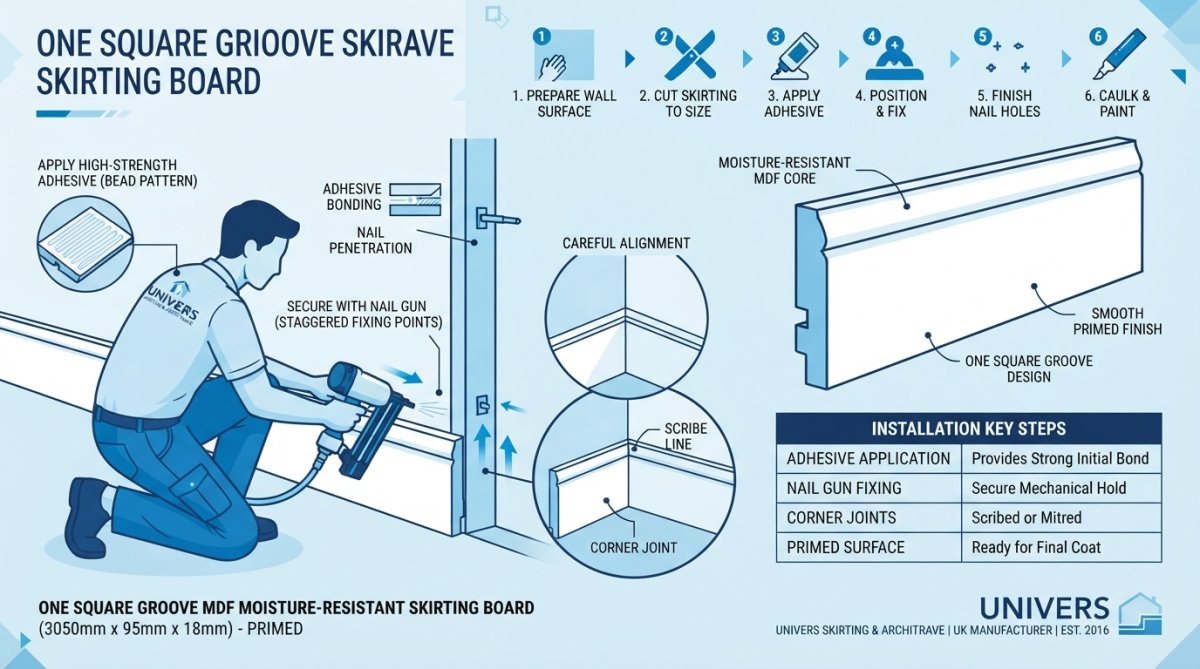
MDF Installation: MDF is straightforward to install. The primed surface means no on-site preparation is needed. You simply fix it to the wall using adhesive and nails or screws. The uniform surface takes paint immediately after installation.
Timber Installation: Timber installation requires more care. Unprimed boards need sanding to remove mill dust and rough spots. If the timber has knots, you'll need knot primer or shellac-based stain blocker to prevent tannins bleeding through topcoat paint. Joints between boards must be carefully fitted because gaps are visible and expand/contract seasonally.
For a DIY enthusiast, MDF is significantly easier. For a professional installer, the labour saving on preparation is offset by the need to be more careful with timber joinery.
DIY Installation Difficulty
MDF skirting is genuinely accessible for competent DIYers. The process is straightforward: mark the line, apply adhesive, fix with nails, caulk joints, and paint. A DIYer with basic tools can install 10-15 metres per day.
Timber skirting requires more skill. You need to sand each board, apply stain blocker to knots, fit joints carefully, and allow wood to acclimatise. A DIYer might manage 5-8 metres per day, and quality depends heavily on experience. For first-time DIYers, MDF is the safer choice.
Preparation and Surface Finish
MDF Preparation:
- Check boards are straight
- Prime any cut edges
- Caulk joints and gaps
- Paint with 2 coats of topcoat
- Total on-site time: 2-3 hours per 10 metres
Timber Preparation:
- Sand all boards to remove mill dust
- Apply knot primer to any knots
- Fill gaps and joints with flexible filler
- Apply undercoat
- Paint with 2 coats of topcoat
- Total on-site time: 6-8 hours per 10 metres
The labour difference is substantial. For trade installers, this translates to higher costs for timber. The final paint finish also differs. MDF accepts paint beautifully because the primed surface is already smooth and uniform. Timber, even when well-sanded, shows grain texture.
Environmental Lifecycle Analysis
MDF is manufactured from wood waste and recycled sawdust, which sounds sustainable. However, the resin binding and industrial processing require energy and chemicals. The material is difficult to recycle and typically ends up in landfill after 20-30 years.
Timber skirting, if sourced from sustainably managed forests (FSC-certified), is renewable. Solid timber also sequesters carbon for decades. At end-of-life, timber can be burned for energy or left to decompose, returning carbon to the soil.
For environmentally conscious homeowners, FSC-certified hardwood is the best option. For those prioritising cost and practicality, moisture-resistant MDF is acceptable; it's made from waste material and lasts 15-25 years. Research from the Forest Stewardship Council shows that FSC-certified timber products have significantly lower environmental impact than conventional logging.
Room-by-Room Recommendations
Bathrooms: Moisture-resistant MDF is the practical choice. Timber will swell and eventually rot, no matter how well-sealed. Use primed, moisture-resistant MDF with a gloss or semi-gloss topcoat.
Kitchens: Either material works, but MDF is safer. Kitchens have steam and occasional splashes. If you prefer timber aesthetics, use hardwood with a gloss or semi-gloss finish and accept that maintenance is required.
Living Rooms and Bedrooms: Both materials perform equally. Choose based on aesthetic preference and budget. If you want a stained finish, timber is necessary. If you want a painted finish and budget is tight, MDF is sensible.
Hallways and High-Traffic Areas: Timber is more durable to impact. MDF will show dents and marks over time. If durability is the priority, choose hardwood timber. If cost is the priority, accept that MDF will need touching up periodically.
Period Properties (Victorian, Edwardian, Georgian): Timber is more authentic, and local planning may require it in conservation areas. Hardwood skirting suits these properties aesthetically. MDF works functionally but looks out of place in period interiors.
Choosing between mdf vs timber skirting pros cons ultimately comes down to three factors: your budget, your room's moisture level, and how long you plan to stay in the property. For most British homes, moisture-resistant MDF skirting offers the best balance of cost, durability, and ease of installation. Univers Skirting & Architrave manufactures premium, fully primed moisture-resistant MDF in five profiles, ready to paint and backed by fast UK delivery. If you're prioritising longevity and aesthetics in a period property or low-moisture room, hardwood timber is worth the investment. Either way, buy quality material, the difference between budget and premium skirting becomes visible within 5 years.
Frequently Asked Questions
Is MDF skirting cheaper than wood skirting in the UK?
Yes, generally. MDF skirting boards typically cost less upfront than solid timber alternatives. For example, quality moisture-resistant MDF skirting starts from around £13.20 per 3050mm board, whilst solid pine and hardwood options often range from £15 to over £90 depending on profile and grade. However, consider long-term durability and repairability when comparing total cost of ownership over the lifetime of your property.
Can moisture-resistant MDF skirting be used in bathrooms and kitchens?
Yes. Modern moisture-resistant MDF skirting is specifically engineered for high-humidity environments like bathrooms and kitchens. Unlike standard MDF, moisture-resistant variants resist swelling and warping caused by water ingress and humidity fluctuations. When properly primed and finished with quality gloss or satin paint, moisture-resistant MDF performs reliably in these rooms, though adequate ventilation remains essential.
Which material is more durable for skirting boards: MDF or timber?
Durability depends on your priorities. Moisture-resistant MDF offers superior dimensional stability and resists warping, splitting and wood movement better than untreated timber. However, solid timber can be sanded and refinished multiple times over decades, extending its lifespan indefinitely with proper maintenance. Timber is more impact-resistant to chipping, whilst MDF is more prone to denting. For UK homes with varying humidity, quality moisture-resistant MDF typically offers better long-term consistency.
How difficult is it to install MDF versus timber skirting boards myself?
Both materials are suitable for DIY installation, though MDF has slight advantages. Moisture-resistant MDF arrives primed and ready to paint, saving preparation time. Timber skirting often requires sanding, knotting and undercoating before decoration. Both require careful measuring, accurate cutting for joints, and proper fixing methods using adhesive and nailing. Timber is more forgiving if you make cuts, as it can be re-sanded; MDF damage is harder to repair invisibly.
What skirting board profiles are available in the UK for both materials?
Both MDF and timber come in extensive profile ranges. Common profiles include bullnose, torus, ogee, pencil round and square edge. Moisture-resistant MDF typically offers 35+ profiles with consistent sizing (often 70-400mm heights). Timber profiles vary by supplier but include traditional designs suited to period properties. MDF profiles maintain exact dimensional stability, whilst timber grain patterns add natural character. Choice often depends on your home's style: modern aesthetics favour clean profiles, whilst period properties suit traditional designs.
This article was written using GrandRanker