

Table of Contents
- Understanding Why MDF Skirting Swells: The Chemistry Behind Moisture Damage
- Choosing Moisture-Resistant MDF Skirting: Your First Line of Defence
- Sealing MDF Edges: Essential Protection Before Installation
- MDF Skirting Installation Tips to Prevent Swelling
- Humidity Control and Ventilation: Long-Term Prevention
- Maintenance Schedule: Protecting Your Skirting Long-Term
- Common Mistakes That Lead to MDF Skirting Swelling
- Conclusion: Preventing Swelling Starts Before Installation
Last Updated: July 24, 2026
Understanding why MDF skirting swells is the first step toward preventing costly damage. At Univers Skirting & Architrave, we've worked with builders and homeowners across the UK who've experienced moisture-related failures. The problem isn't MDF itself, it's how moisture penetrates the material and causes the binders to absorb water, expanding the board beyond its original dimensions. This guide covers practical strategies backed by the chemistry of what happens when water meets medium density fibreboard.
Most guides focus only on surface sealing, but that misses half the battle. The real solution combines material selection, edge protection, installation technique, and long-term environmental control.
Understanding Why MDF Skirting Swells: The Chemistry Behind Moisture Damage
MDF is engineered wood made from wood fibres bonded together with synthetic resin under heat and pressure. The binders and resin that hold the fibres together are hygroscopic, meaning they absorb moisture from the air. When humidity levels rise, particularly in bathrooms, kitchens, or damp basements, water molecules migrate into the board's structure through capillary action.
Capillary action is how water travels through porous materials against gravity. In MDF skirting, this process happens when the board's cut edges contact damp subfloors, condensation, or splashing water. The exposed edge grain acts like a drinking straw, pulling moisture deep into the board's core. Once inside, water swells the wood fibres and weakens the resin bonds. The board expands unevenly, often bulging outward at the base, and the surface paint cracks.
Standard MDF swells noticeably even at moderate humidity levels (above 65%). Cheaper MDF uses lower-quality urea-formaldehyde resins that break down faster when wet. Better-quality boards use melamine-urea-formaldehyde or phenol-formaldehyde binders, which resist moisture longer but still aren't waterproof. This material difference is critical before installation.
Damage typically appears within 6-18 months of installation if moisture control is poor. You'll see the bottom edge swelling, paint bubbling, or the board separating from the wall. By that point, replacement is often the only option.
Choosing Moisture-Resistant MDF Skirting: Your First Line of Defence
Your material choice determines how much protection you'll need later. Standard MDF offers minimal resistance to moisture, while MR (moisture-resistant) MDF is specifically engineered to handle humid environments. The difference lies in the resin binder and sometimes the addition of wax emulsion throughout the board's core.
MR MDF uses phenol-formaldehyde or melamine-urea-formaldehyde binders that resist water absorption significantly better than standard urea-formaldehyde. These resins slow moisture absorption and reduce swelling by 30-50% compared to standard MDF. For high-moisture areas like bathrooms and kitchens, this difference is foundational to your protection strategy.
Primed skirting boards offer an additional advantage. Univers Skirting & Architrave supplies moisture-resistant MDF skirting boards pre-primed and ready to paint, which saves a critical step on site. The primer coat seals the face and edges before installation, reducing the window during which bare MDF can absorb moisture.
When selecting skirting, specify MR MDF explicitly. Standard MDF is cheaper but will cost far more in repairs and replacements. For bathrooms, en-suites, and kitchens, this is non-negotiable.
Sealing MDF Edges: Essential Protection Before Installation
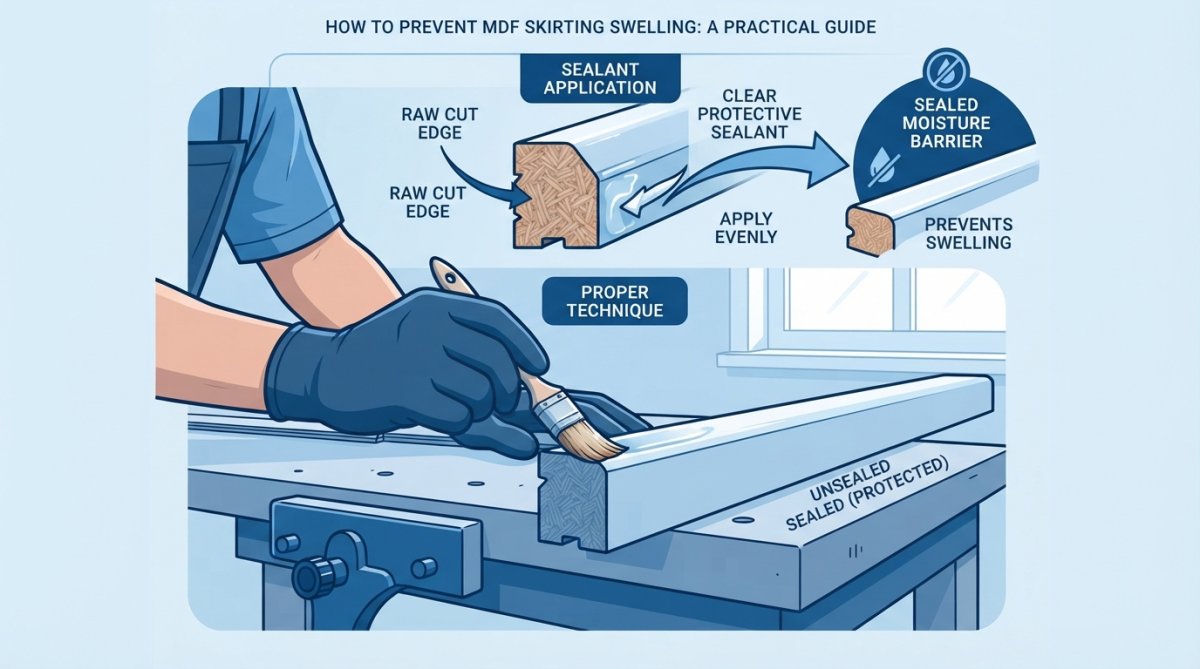
The edges are where 80% of moisture problems originate. Cut edges expose the board's internal structure directly, creating a superhighway for capillary water absorption. Sealing those edges before installation is the single most effective step you can take.
Three sealant types work best: acrylic primer, polyurethane sealers, and flexible silicone.
Acrylic primer is the most common choice and works well for most installations. It's water-based, dries quickly, and provides a good moisture barrier. The downside is that it's not flexible, as the board expands and contracts, the primer can crack. For standard skirting in living areas, this is acceptable.
Polyurethane sealers offer superior moisture protection and flexibility. They maintain their seal even as the board moves slightly. The trade-off is cost and application difficulty, polyurethane requires careful mixing and has a shorter working time. For bathrooms and kitchens, polyurethane is worth the extra effort.
Silicone-based flexible sealants are best reserved for joints and gaps rather than broad edge coverage. They're excellent for sealing the expansion gap between skirting and flooring but too expensive for sealing the entire bottom edge.
Sand the cut edges lightly with 120-grit sandpaper to remove splinters and create a rougher surface for better primer adhesion. Wipe away dust with a damp cloth and let dry completely. Apply the primer or polyurethane with a brush along the entire cut edge and the bottom 50mm of the board's back face. Two coats provide better protection than one, particularly on the bottom edge closest to the subfloor.
Apply the sealant before the board arrives on site if possible, or seal it immediately upon delivery. Allow the sealant to cure fully (typically 24 hours for acrylic, 48 hours for polyurethane) before installation.
MDF Skirting Installation Tips to Prevent Swelling
How you install the board matters as much as what you install. Poor installation technique can undo all your sealing work.
First, prepare the subfloor properly. If the subfloor is damp, seal it before installing skirting. Damp-proof membranes prevent ground moisture from wicking up into the board. For ground-floor installations, this is essential. Check the subfloor moisture content with a moisture meter; readings above 15% indicate dampness that needs addressing before skirting goes down.
Use plastic packers or shims to create a small gap between the skirting board and the subfloor. This expansion gap, typically 10-12mm, allows air to circulate underneath and prevents direct contact with potentially damp flooring. It also accommodates the slight expansion that occurs naturally with humidity changes.
Secure the board with appropriate fixings spaced 400-600mm apart, but avoid over-tightening. If you drive screws too hard, you can compress the MDF and create stress points that fail when the board expands. Leave the fixings slightly loose enough that the board can move slightly as humidity changes.
For internal corners and joints, maintain small expansion gaps here too. A flexible sealant (not rigid caulk) fills these gaps, allowing the boards to move independently while maintaining a neat appearance.
Humidity Control and Ventilation: Long-Term Prevention
Even with perfect sealing and installation, poor environmental conditions will eventually cause problems. Humidity control is the invisible foundation of long-term skirting protection.
Maintain indoor humidity between 40-60% relative humidity. Above 65%, moisture absorption accelerates dramatically. In bathrooms and kitchens, install extract fans and run them during and for 20-30 minutes after showers or cooking. Ensure fans vent to outside, not into loft spaces where moisture can accumulate.
Ventilation prevents condensation, a major culprit in moisture damage. Condensation forms on cool surfaces when warm, humid air meets cold walls or floors. Proper ventilation removes that moisture-laden air before it can settle on the skirting. Open windows briefly after moisture-generating activities to exchange indoor air with drier outside air.
Monitor humidity levels with an inexpensive hygrometer. Place it in high-risk areas like bathrooms and kitchens. If readings consistently exceed 65%, increase ventilation or consider a dehumidifier.
Avoid direct water contact. Ensure gutters and downpipes direct water away from the building. Check for leaks around windows and doors that could allow water to run down internal walls.
Maintenance Schedule: Protecting Your Skirting Long-Term
Prevention doesn't end at installation. Annual maintenance catches problems early, when they're still fixable.
Inspect skirting boards each year, particularly in spring after winter condensation risk has passed. Look for signs of swelling at the bottom edge, paint bubbling, or separation from the wall. Check expansion gaps to ensure they're clear of debris and still functioning.
Refresh the protective coating every 3-5 years, depending on humidity exposure. In bathrooms and kitchens, do this more frequently, every 2-3 years. A fresh coat of primer and paint seals any cracks that may have developed and restores the moisture barrier.
If you spot minor swelling (less than 2mm) early, the board may be salvageable. Remove it carefully, allow it to dry completely in a warm, dry environment, and then reseal it before reinstalling. Drying typically takes 2-4 weeks. Once dry, sand the swollen area smooth, apply fresh primer and paint, and reinstall with proper gaps and ventilation.
For severe swelling (more than 5mm), replacement is usually necessary. The structural integrity is compromised, and attempting to repair it wastes time and money.
Common Mistakes That Lead to MDF Skirting Swelling
Understanding what goes wrong helps you avoid it.
Installing standard MDF in moisture-prone areas is the first and most costly mistake. Builders sometimes choose standard MDF to save £1-2 per metre, only to face complaints and replacement costs within 18 months. MR MDF costs slightly more upfront but eliminates most moisture problems.
Skipping edge sealing is the second major error. Sealant takes time and adds cost, so some installers skip it entirely or seal only the visible edges, leaving the bottom edge exposed. Every edge must be sealed, with particular attention to the bottom edge and back face.
Omitting expansion gaps is surprisingly common. Some installers push the skirting tight against the floor and caulk the gap completely with rigid caulk. This traps moisture and prevents air circulation. The expansion gap is essential.
Poor ventilation and humidity control are often the installer's responsibility to recommend but the building occupant's responsibility to maintain. A perfectly installed board will still swell if the bathroom has no extract fan and humidity runs at 75% year-round.
Using cheap, low-quality primer is another false economy. Budget primers offer minimal moisture protection and often crack within a year. Invest in quality acrylic primer or polyurethane sealer that will actually seal the wood.
Conclusion: Preventing Swelling Starts Before Installation
MDF skirting swelling is entirely preventable when you approach it systematically. The strategy has four pillars: choose MR MDF instead of standard, seal every edge before installation, create expansion gaps that allow air circulation, and maintain humidity control long-term.
Univers Skirting & Architrave supplies moisture-resistant MDF skirting boards pre-primed and ready to paint, eliminating the risk of installing unsealed boards. Our UK moisture-resistant building standards compliant profiles come in a range of styles, V Groove, One Square Groove, Pencil Round, and Ogee, all engineered to resist moisture better than standard MDF. With free UK delivery on orders over £150 and made-to-order solutions for custom projects, we've helped thousands of metres of skirting stay protected across British homes.
Start by specifying the right material, seal edges properly, install with gaps, and monitor humidity. Follow these steps and you'll avoid the swelling, warping, and paint failure that plague cheaper installations.
Frequently Asked Questions
What causes MDF skirting to swell?
MDF swells when moisture penetrates the board through capillary action, causing the wood fibres and binders to expand. This happens most often in bathrooms, kitchens, and areas with high humidity or condensation. Standard MDF is particularly vulnerable because its binder system absorbs water readily. Using moisture-resistant MDF and proper sealing significantly reduces this risk.
How do I seal MDF edges to prevent moisture absorption?
Apply a quality acrylic primer or flexible sealant to all cut edges and the back of the board before installation. For high-moisture areas, polyurethane or silicone-based sealants offer superior water resistance. Sand lightly between coats, and ensure complete coverage of exposed edges. This creates a protective barrier that prevents water ingress and helps prevent MDF skirting swelling.
Is moisture-resistant MDF skirting truly waterproof?
Moisture-resistant (MR) MDF is not waterproof, but significantly more resistant to swelling than standard MDF. It uses specialised binders that repel water better. However, MR MDF still requires proper sealing, installation with expansion gaps, and good humidity control. Combined with these measures, MR MDF provides excellent durability in British homes, even in wet areas.
What's the best way to store MDF skirting before installation?
Store MDF skirting boards flat in a dry, well-ventilated space with relative humidity between 35-65%. Keep them off damp floors using timber battens or shelving. Avoid stacking too heavily, which can cause warping. Allow the boards to acclimatise to your home's humidity for 24-48 hours before installation. Proper storage prevents moisture absorption before sealing and installation even begin.
Moisture damage to skirting boards costs money and disrupts your space. Univers Skirting & Architrave's moisture-resistant, pre-primed profiles are designed specifically for British homes where humidity and condensation are real challenges. Choose a board built to last, seal it properly, and protect your investment for years to come.
This article was written using GrandRanker