

Table of Contents
- How to Paint MDF Skirting Perfectly: What You Need to Know
- Surface Preparation and Cleaning
- Sanding MDF Before Painting
- Best Primer for MDF Skirting Boards
- Sealing MDF Edges for Moisture Resistance
- Types of Paint for Skirting Boards
- Painting Techniques and Application Methods
- Drying Times, Temperature Control, and Multiple Coats
Last Updated: July 27, 2026
How to Paint MDF Skirting Perfectly: What You Need to Know
Achieving a professional finish on MDF skirting boards requires understanding how to paint MDF skirting perfectly, the process differs significantly from painting solid wood. At Univers Skirting & Architrave, we've guided thousands of homeowners and trade professionals through this process. When done correctly, MDF skirting delivers a smooth, durable finish that rivals traditional timber at a fraction of the cost. The challenge isn't complexity; it's that most people skip or rush the preparation stages, which determine 80% of finish quality.
MDF presents unique challenges that solid wood doesn't. The material is porous in places and prone to swelling when exposed to moisture, which makes British homes particularly demanding environments. This guide covers the complete process, including edge sealing for moisture resistance, primer selection, and troubleshooting common defects.
Why MDF Skirting Requires Different Preparation
Most guides treat MDF the same as solid wood, which leads to disappointing results. MDF's structure, compressed wood fibres bonded with resin, creates a surface that behaves completely differently when painted. Unlike timber, it has dense areas and softer areas that absorb paint at different rates, leading to visible lap marks and uneven sheen if you don't follow the right process.
The British climate adds another layer of complexity. Humidity fluctuations cause MDF to expand and contract, which is why edge sealing matters so much in UK homes. Bathrooms, kitchens, and poorly ventilated rooms are particularly harsh environments for unprepared MDF. Preparation, not paint quality, determines your success.
Surface Preparation and Cleaning
Start by inspecting your MDF skirting for any manufacturing defects, dents, or damage. Vacuum thoroughly along the entire length using a soft brush attachment, paying attention to grooves and profile details where dust accumulates.
Next, degrease the surface. Even new MDF can have manufacturing oils or handling residue. Use a clean cloth slightly dampened with white spirit or a commercial degreaser, working along the length of the board. This step is critical for primer adhesion.
After degreasing, allow the skirting to dry completely, typically 30 minutes to an hour. Once dry, use a tack cloth to remove any remaining dust particles, paying special attention to grooves and moulded details.
| Preparation Stage | Action | Duration | Why It Matters |
|---|---|---|---|
| Inspection | Check for defects and damage | 10 minutes | Identifies issues before painting |
| Vacuuming | Remove loose dust with soft brush | 15 minutes | Prevents particles in finish |
| Degreasing | Wipe with white spirit or degreaser | 20 minutes | Improves primer adhesion |
| Drying | Allow 30-60 minutes | 30-60 minutes | Ensures clean surface for primer |
| Tack cloth | Final dust removal | 10 minutes | Eliminates microscopic particles |
Sanding MDF Before Painting
Sanding removes any factory finish and opens the surface to accept primer evenly. Use fine-grit sandpaper, typically 150-180 grit. Coarser grits create scratches visible through paint; finer grits don't cut through the factory primer effectively.
Sand by hand using a sanding block rather than a power sander. Work along the length of the board with light pressure, using long, even strokes. The goal is to dull the surface and remove any sheen. Pay particular attention to the top edge and moulded details, which receive the most visual scrutiny.
After sanding, vacuum again with a soft brush, then use the tack cloth a second time.
Best Primer for MDF Skirting Boards
Primer is where many DIY painters economise, and it's the wrong place to cut costs. For MDF skirting, you need a high-adhesion primer specifically formulated for non-porous surfaces. Look for primers labelled "high-adhesion" or "all-surface" primers. Solvent-based primers provide superior adhesion, though water-based high-adhesion primers are now acceptable alternatives if you prefer lower VOC.
Apply primer with a synthetic bristle brush in thin, even coats. Use long, smooth strokes, maintaining a wet edge to avoid lap marks. A single coat of quality primer is usually sufficient, though heavily sanded areas may benefit from two thin coats.
Allow primer to dry fully according to manufacturer instructions, typically 2-4 hours for water-based primers, 4-8 hours for solvent-based. Don't rush this stage.
Sealing MDF Edges for Moisture Resistance
MDF edges are the most vulnerable part of the board, they're end-grain, highly absorbent, and the first place moisture penetrates. In bathrooms, kitchens, or any humid environment, unsealed edges will absorb moisture, swell, and eventually cause the entire board to warp.
After primer has dried, apply an edge sealer specifically designed for MDF with a small brush, coating the edges thoroughly. Pay special attention to the bottom edge, which is most exposed to floor-level moisture and condensation. Allow edge sealer to cure fully, typically 24 hours.
Some premium MDF suppliers, including Univers Skirting & Architrave, offer pre-sealed moisture-resistant MDF profiles that have edge protection built in, eliminating this step entirely.
Types of Paint for Skirting Boards
Water-based acrylic paints are the modern standard. They dry quickly (2-4 hours), have low odour, clean up with water, and emit fewer VOCs than solvent-based paints. Quality matters significantly; cheap water-based paints can look thin and chalky, while premium formulations deliver excellent coverage and sheen.
Solvent-based (oil-based) paints provide superior durability and a harder finish, making them popular with professional decorators. They take longer to dry (8-16 hours) and require solvent for cleanup. For skirting boards that will receive wear and scuffing, particularly in high-traffic areas or homes with children and pets, solvent-based paint's durability advantage is worth the longer drying time.
Choose a paint formulated for trim and woodwork. These are harder-wearing than wall paints and resist scuffing and marking better. Satin or semi-gloss finishes are standard for skirting; they're more durable than matt finishes and easier to clean when marked.
Painting Techniques and Application Methods
The technique you use to apply paint matters as much as the paint itself. Brush strokes, maintaining a wet edge, and consistent pressure all determine whether your finish looks amateur or professional.
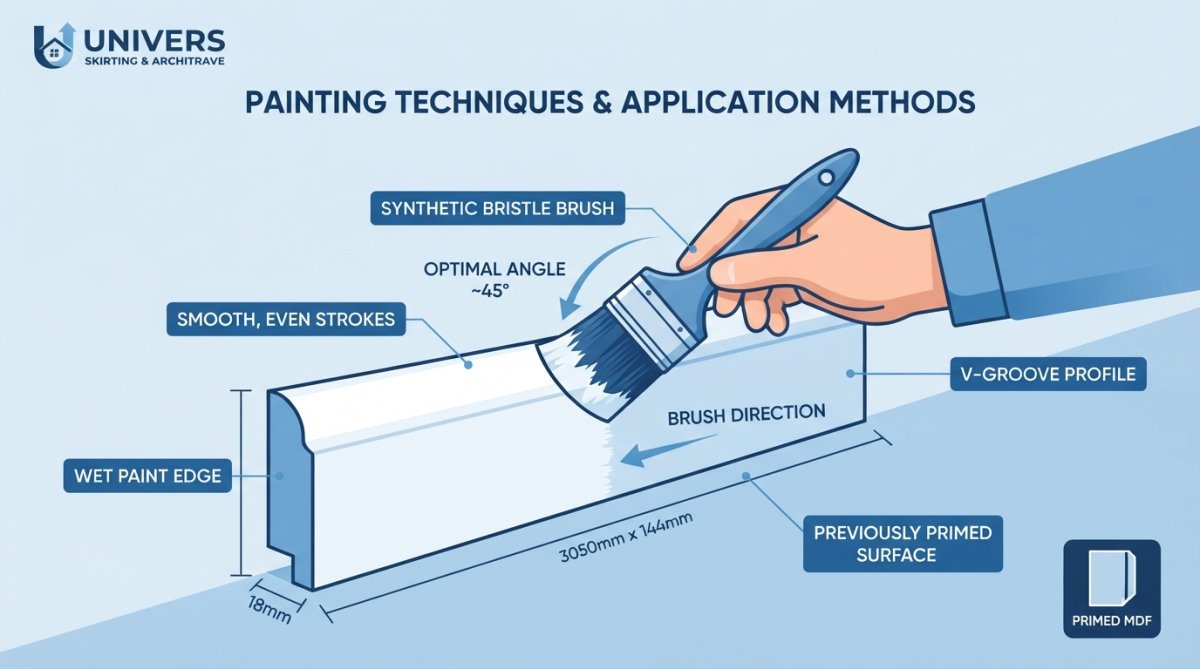
For skirting boards, a synthetic bristle brush is the right tool. Natural bristles absorb water and splay in water-based paints, creating visible brush strokes. A 2-3 inch brush is ideal for most skirting profiles.
Load your brush with paint, but don't overload it. Dip the brush about one-third of the way into the paint, tap gently on the side of the tin to remove excess, and apply with smooth, long strokes along the length of the skirting. Maintain a wet edge, which means keeping a continuous band of wet paint as you work, preventing lap marks where one section dries before the next is applied.
Work in sections, typically 2-3 metres at a time. Apply paint in the direction of the moulding profile where possible. For detailed mouldings, a slightly smaller or angled brush helps you get into grooves without leaving thick paint in corners.
Drying Times, Temperature Control, and Multiple Coats
Drying time is not just about waiting before you can walk on the skirting. It's about allowing paint to cure properly, which determines the final hardness and durability of your finish. Temperature and humidity dramatically affect drying speed.
Water-based acrylics dry faster in warm, dry conditions, typically 2-4 hours to touch-dry, though full hardness takes 24 hours. Solvent-based paints dry more slowly, 4-8 hours to touch-dry, 16-24 hours to full hardness. In cool, damp conditions, add 50% to these times.
Ambient temperature should be between 15°C and 25°C for optimal drying. Below 15°C, paint dries very slowly and may not cure properly. In British homes during winter, paint skirting during mild weather if possible, or heat the room gently to maintain temperature within the ideal range.
The two-coat system is standard for professional skirting finishes. The first coat provides coverage and seals the primer. The second coat builds depth and improves durability. Between coats, lightly sand with 220-grit paper to remove any dust particles and improve adhesion. Vacuum and tack cloth again before applying the second coat.
| Coat | Purpose | Drying Time | Sanding After |
|---|---|---|---|
| Primer | Seal and adhesion base | 2-8 hours | Light sand with 150-180 grit |
| First Topcoat | Coverage and colour | 4-24 hours | Light sand with 220 grit |
| Second Topcoat | Durability and final finish | 24 hours | Final inspection only |
Troubleshooting Common Finish Defects
Even with proper technique, defects sometimes appear. Understanding what went wrong helps you fix it and avoid the problem next time.
Blotchy, uneven finish typically indicates uneven primer application or inadequate sealing of the MDF surface. Sand back the affected area, re-prime, and reapply topcoat. Prevention: ensure primer is applied uniformly and has fully sealed the surface.
Visible brush strokes after the paint dries mean you either used natural bristles, applied paint too thickly, or didn't maintain a wet edge. Synthetic bristles, thinner application, and working methodically prevent this. If it's already happened, sand the affected area with 220-grit paper and reapply topcoat.
Peeling or adhesion failure weeks after painting indicates moisture penetration or inadequate primer. Seal edges thoroughly before topcoat and ensure primer fully covers all surfaces.
Sagging or drips happen when too much paint is applied at once. Use less paint per brush load and apply thinner coats. If drips have already dried, sand them smooth with 220-grit paper and feather the area with a light topcoat.
Eco-Friendly and Low-VOC Paint Options
Low-VOC and zero-VOC water-based paints have been reformulated to eliminate or nearly eliminate volatile organic compounds while maintaining comparable performance. Brands like Farrow & Ball, Little Greene, and Earthborn offer premium low-VOC options specifically designed for trim and woodwork. They cost more than standard paints but provide peace of mind if you're painting in occupied homes or have chemical sensitivities.
For most homeowners, a standard water-based acrylic from a reputable brand delivers excellent results at reasonable cost.
Maintenance and Touch-Up Guide
Your painted skirting will need occasional maintenance to keep it looking fresh. Regular cleaning prevents dust buildup and keeps the finish bright. Use a soft cloth slightly dampened with water and a tiny amount of mild detergent. Wipe gently; aggressive scrubbing can dull the finish.
Scuffs and marks are inevitable on skirting boards, particularly in homes with children or pets. Minor marks can often be wiped away with a slightly damp cloth. Deeper scuffs may require light sanding with 220-grit paper followed by a touch-up with topcoat paint.
For touch-ups, keep leftover paint from your original project. Paint ages and can separate, so stir thoroughly before use. Apply touch-up paint with a small brush, feathering the edges to blend with the surrounding finish.
Painting MDF skirting perfectly is achievable when you follow the complete process from preparation through final topcoat. The key is understanding that primer, sanding, and edge sealing determine your success far more than paint quality alone. Univers Skirting & Architrave manufactures moisture-resistant MDF skirting boards that arrive pre-primed and ready to paint, eliminating factory primer uncertainty and saving you preparation time. Our profiles are available in multiple styles, from simple Square Edge to detailed Ogee and Ovolo designs, and all feature built-in moisture resistance for British homes. With proper technique and quality materials, your skirting will maintain its finish for years, delivering the professional appearance that transforms a room.
Frequently Asked Questions
Do you have to prime MDF skirting before painting?
Yes, priming is essential for MDF skirting. MDF is a non-porous, engineered material that requires a high-adhesion primer to ensure proper paint adhesion and a professional finish. Even pre-primed skirting boards benefit from a light sand and primer application on raw edges and any damaged areas. A quality primer creates a sealed surface that prevents paint from absorbing unevenly, which would result in a blotchy, unprofessional appearance.
What is the best primer for MDF skirting boards?
A high-adhesion, purpose-designed MDF primer is your best choice. Look for primers specifically formulated for non-porous surfaces that offer excellent paint adhesion and quick drying times. Water-based primers are popular for indoor use due to low odour and easy cleanup, whilst solvent-based options provide superior durability in moisture-prone areas like bathrooms. Apply primer thinly and evenly using a synthetic bristle brush or roller, and ensure it's fully dry before sanding lightly and applying your topcoat.
How do you get a smooth finish on MDF skirting without brush strokes?
Achieving a smooth finish requires proper technique and the right tools. Use a high-quality synthetic bristle brush or foam roller to minimise brush marks. Apply paint in thin, even coats rather than one thick coat, this prevents drips and allows the surface to dry evenly. Sand lightly between coats with fine-grit sandpaper, and use a tack cloth to remove dust before applying the final coat. Maintain consistent ambient temperature and avoid painting in cold, damp conditions, as these affect drying and finish quality.
Can you paint MDF skirting without sanding?
Whilst technically possible on pre-primed boards in good condition, light sanding is strongly recommended for a professional result. Sanding with fine-grit sandpaper (220-240 grit) removes dust, minor imperfections, and surface irregularities, improving paint adhesion and topcoat appearance. For raw MDF or boards with damage, sanding is essential. It also helps blend any primer imperfections and creates a slightly textured surface that helps paint adhere better, resulting in a more durable, longer-lasting finish.
How long does primer take to dry on MDF skirting?
Drying time depends on the primer type and ambient conditions. Water-based primers typically dry to touch in 1-2 hours and are ready for light sanding or a second coat within 4-6 hours. Solvent-based primers may take 8-24 hours to fully cure. Always check the manufacturer's instructions, as temperature and humidity significantly affect drying. In cool, damp British conditions, allow extra time, rushing between coats can result in poor adhesion and a compromised finish.
What grit sandpaper should I use for MDF skirting?
Use fine-grit sandpaper in the 220-240 grit range for MDF skirting. This grit is fine enough to smooth the surface without gouging or damaging the material, yet coarse enough to remove dust and imperfections effectively. For initial surface preparation on raw or damaged areas, start with 180 grit, then finish with 220-240 grit for a smooth topcoat. Always sand with the grain direction where possible, use a sanding block to maintain even pressure, and finish with a tack cloth to remove all dust before priming or painting.
Is moisture-resistant MDF better for skirting in bathrooms?
Yes, moisture-resistant (MR) MDF is significantly better for bathrooms and other damp areas. Standard MDF can swell and warp when exposed to prolonged moisture, whilst MR MDF is engineered to resist moisture absorption. Univers Skirting & Architrave manufactures moisture-resistant MDF skirting boards specifically designed for British homes, where humidity and moisture exposure are common. Pairing MR MDF with proper edge sealing and a quality water-resistant paint creates a durable, long-lasting finish that resists warping and damage in challenging environments.
This article was written using GrandRanker