

Table of Contents
- What Are High Quality MDF Profile Finishes?
- Types of MDF Profile Finishes Explained
- MDF Skirting Board Finishes: Durability and Application
- Durable MDF Finishes: What Makes Them Last
- Choosing the Right High Quality MDF Profile Finish
- Surface Preparation and Application Best Practice
- Conclusion
High Quality MDF Profile Finishes: The Complete Guide
Last Updated: July 29, 2026
When it comes to interior finishing, the difference between a professional result and a disappointing one often comes down to one critical decision: the quality of your MDF profile finishes. At Univers Skirting & Architrave, we've spent over a decade helping both trade professionals and homeowners achieve durable, seamless finishes that last. High quality MDF profile finishes aren't simply about appearance, they're about selecting the right substrate, understanding moisture resistance, and applying the correct topcoats for your specific environment.
What Are High Quality MDF Profile Finishes?
High quality MDF profile finishes refer to engineered wood mouldings that combine moisture-resistant MDF substrate with factory-applied primer or veneer, ready for final decoration. Unlike solid timber or cheap unprimed alternatives, quality MDF profiles offer dimensional stability, consistent grain, and compatibility with modern acrylic and polyurethane topcoats. The "quality" isn't just about the wood product itself, it's about the entire system: the primer formulation, edge sealing treatment, and how well the manufacturer has prepared the substrate for site application. A well-primed profile arrives ready to paint after a light sand, saving 2-3 hours per project for typical skirting installations.
Types of MDF Profile Finishes Explained
The MDF finish landscape breaks into three main categories, each serving different project requirements and aesthetic goals.
Primed MDF Profiles: Ready-to-Paint Solutions
Primed MDF profiles arrive with a factory-applied primer coat, typically an acrylic or solvent-based formulation designed to seal the porous substrate and prepare it for topcoat application. This is the most practical option for trade professionals and homeowners who plan to paint their skirting boards and architraves on site. Quality primers penetrate the MDF surface and bind to the grain, while inferior primers sit on the surface and can flake or chip under pressure. When you order primed profiles from Univers Skirting & Architrave, each piece arrives with a twice-primed finish. For a typical kitchen renovation requiring 40 metres of skirting, this saves approximately 6-8 hours of preparation work compared to unprimed alternatives.
Veneered and Laminated MDF Profiles
Veneered MDF profiles combine an MDF core with a thin layer of real timber veneer, typically white oak, ash, or walnut, bonded to the visible surface. Laminated profiles use a decorative film or plastic coating instead. Both arrive fully finished and require no painting, making them ideal for projects where natural wood aesthetics are essential. Veneered profiles offer the visual appeal of solid timber at a fraction of the cost and with superior dimensional stability. Unlike solid timber mouldings, veneered MDF won't warp, twist, or develop gaps as humidity fluctuates. However, veneered finishes require careful handling on site and edges must be sealed with matching timber edge banding to prevent moisture ingress and veneer lifting.
Moisture-Resistant Finishes for Bathrooms and Kitchens
Moisture-resistant MDF profiles are manufactured using a special resin formulation that resists swelling and warping when exposed to high humidity and temperature fluctuations. These profiles are essential in bathrooms, en-suites, and kitchens where standard MDF would swell, warp, and eventually fail. The moisture resistance is built into the MDF itself during manufacturing through the use of melamine or phenol-formaldehyde resin, which repels water and maintains dimensional stability even in saturated environments. Univers Skirting & Architrave manufactures all profiles from moisture-resistant MDF, making them suitable for bathrooms without additional treatment.
MDF Skirting Board Finishes: Durability and Application
MDF skirting boards represent the largest application for quality profile finishes in British homes. The finish must be durable, easy to maintain, and resistant to scuffing and impact damage.
Paint and Topcoat Compatibility
The choice of topcoat dramatically affects the longevity and appearance of your finished skirting boards. Acrylic latex paints offer ease of application, low VOC levels, and fast drying times, ideal for residential projects. Oil-based paints deliver superior durability and harder finishes, but require longer drying times and solvent cleanup. For primed MDF skirting boards, both acrylic and oil-based topcoats adhere well, provided the primer is compatible. A solvent-based primer accepts both acrylic and oil-based topcoats, while a latex primer may reject oil-based topcoats, causing peeling and adhesion failure. Polyurethane topcoats offer exceptional durability for high-traffic areas and kitchens, creating a seamless, hard-wearing surface that resists staining and impact damage.
Edge Sealing and Grain Raising Prevention
The edges of MDF profiles are the most vulnerable points in the finish system. MDF edges are porous and absorb moisture readily, leading to swelling, grain raising, and primer failure. Quality manufacturers address this through edge sealing, applying primer or sealant to the cut edges and back surface before delivery. Grain raising occurs when water penetrates the MDF surface, causing fibres to swell and stand proud of the surface. Preventing grain raising requires sealing the edges and applying a sanding sealer before your final topcoat. In bathrooms, seal the back surface with a moisture-resistant primer to prevent moisture ingress from behind. This step takes 30 minutes for a typical room but prevents failure that would otherwise occur within 2-3 years.
Durable MDF Finishes: What Makes Them Last
Durability in MDF profile finishes depends on three factors: substrate quality, finish system specification, and environmental conditions.
Environmental Factors and VOC Levels
Volatile organic compounds (VOCs) in primers and paints affect both indoor air quality and finish durability. Low-VOC and zero-VOC products are increasingly standard in the UK market, but VOC content also affects how well a finish cures and hardens. Some zero-VOC primers cure more slowly and may not achieve full hardness for 4-6 weeks, compared to 1-2 weeks for traditional solvent-based products. In a heated, dry living room with stable humidity, slower-curing low-VOC primers perform excellently. In a bathroom with daily humidity spikes or a kitchen with temperature fluctuations, traditional solvent-based primers often deliver superior durability.
Temperature cycling also affects finish durability. Kitchens experience temperature swings from cool mornings to hot cooking periods, causing expansion and contraction in the MDF substrate and finish layers. Quality finishes use flexible topcoats (acrylic latex or polyurethane) that move with the substrate without cracking. Brittle finishes will crack and peel under temperature cycling within 12-18 months.
Troubleshooting Common Finish Failures
Peeling paint typically results from incompatible primer and topcoat, inadequate surface preparation, or moisture ingress from behind. If your skirting boards are peeling within 6-12 months, the primer and topcoat are likely incompatible, or the back surface wasn't sealed against moisture. Grain raising appears as a rough, raised texture on the surface, indicating that moisture has penetrated the primer. Prevention through edge sealing and sanding sealer application is far more effective than attempting to sand and refinish after grain raising has occurred. Crazing, fine cracks in the paint surface, indicates that the topcoat has dried too quickly or is too brittle for the substrate movement. Using quality paints and avoiding application in direct sunlight prevents this issue.
Choosing the Right High Quality MDF Profile Finish
Selecting the right finish for your project requires matching the profile style, finish type, and topcoat to your specific application and timeline.
Profile Styles and Aesthetic Versatility
MDF profiles come in dozens of styles, from simple square edge to ornate ogee and ovolo profiles. Square edge profiles suit modern, minimalist interiors. Ogee and ovolo profiles deliver traditional character for period properties. Torus and bullnose profiles offer classic proportions that work in both traditional and contemporary spaces. Primed profiles are ideal for contemporary spaces where you'll apply a single colour paint finish. Veneered profiles suit period properties where natural timber character is desired. Moisture-resistant finishes are essential for any profile installed in bathrooms or kitchens, regardless of style.
Selection Matrix for Trade and Homeowners
| Project Type | Environment | Recommended Finish | Why |
|---|---|---|---|
| New build living room | Dry, stable humidity | Primed acrylic topcoat | Fast application, low VOC, durable |
| Victorian renovation | Living areas | Veneered white oak | Period authenticity, stability vs. solid timber |
| Kitchen renovation | Moderate moisture | Moisture-resistant primed + polyurethane | Water resistance, hard-wearing finish |
| Bathroom | High humidity, temperature cycling | Moisture-resistant primed + acrylic latex | Full moisture protection, flexible topcoat |
| Rental property | Multiple environments | Moisture-resistant primed | Future-proof for any room type |
Surface Preparation and Application Best Practice
The difference between a professional finish and an amateur result lies almost entirely in surface preparation.
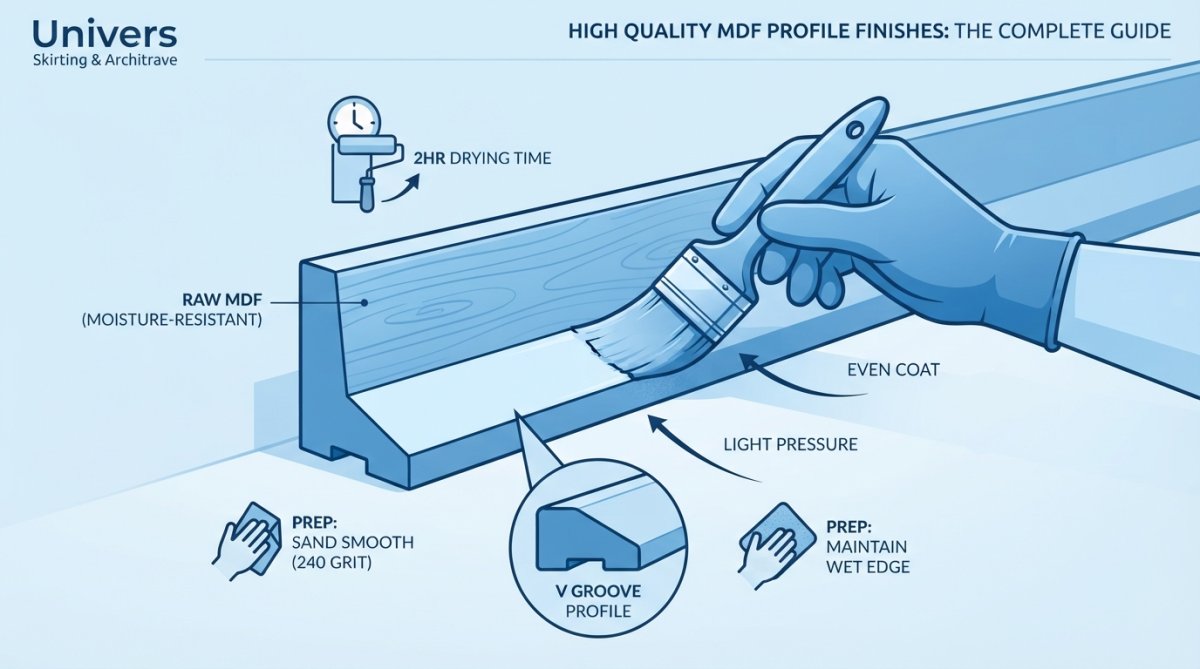
Sanding, Sealing, and Primer Application Steps
For primed profiles arriving on site, the preparation sequence is:
- Inspect the delivery - Check for damage, warping, or defects before installation.
- Install the profiles - Fix skirting boards or architraves to the wall using appropriate fixings.
- Fill gaps and joints - Use flexible acrylic filler to seal gaps between profiles and at corners.
- Light sand the surface - Use 180-220 grit sandpaper to remove raised grain and abrade the primer.
- Apply sanding sealer - Brush or spray sanding sealer to all surfaces, edges, and the back of the profile.
- Final sand - Lightly sand with 220+ grit paper to remove dust nibs.
- Apply topcoat - Apply your chosen paint finish according to manufacturer instructions, typically requiring 2 coats.
Achieving a Seamless Finish
A seamless finish means no visible joints, grain raising, or colour variations across the installed profiles. Gap filling is critical because gaps between profiles will telegraph through paint. Use flexible acrylic filler that moves with the substrate, as rigid fillers crack as the MDF expands and contracts. Fill gaps slightly proud of the surface, then sand flush once dry. Colour consistency depends on consistent primer coverage and topcoat application. Apply primer in thin, even coats rather than one thick coat, sanding between coats. For topcoat application, use quality brushes or foam rollers designed for the specific paint type. Apply topcoat in thin, even coats in the direction of the profile grain.
Choosing high quality MDF profile finishes for your project eliminates the uncertainty of budget alternatives and ensures finishes that remain durable for 10+ years. Univers Skirting & Architrave manufactures all profiles from moisture-resistant MDF with twice-primed factory finishes, reducing your on-site preparation time and guaranteeing compatibility with standard UK topcoats. Whether you're specifying for a trade project or renovating your home, starting with premium primed profiles and following proper surface preparation delivers professional results that last. UK Building Regulations for interior finishes and moisture resistance outlines the standards your finishes must meet, and quality manufacturers like Univers Skirting & Architrave ensure compliance from the start.
Frequently Asked Questions
What makes high quality MDF profile finishes different from standard finishes?
High quality MDF profile finishes combine superior moisture-resistant substrate with proper priming and topcoat systems. They feature twice-primed applications, edge sealing to prevent grain raising, and compatibility with acrylic or oil-based topcoats. Quality finishes resist warping in bathrooms and kitchens, maintain durability across British climate conditions, and provide a seamless appearance ready for paint or staining.
How do primed MDF profiles save time on site compared to unprimed options?
Primed MDF profiles arrive ready for immediate topcoat application, eliminating the need for on-site sanding sealer and primer coats. This reduces labour time by one to two days per project. However, high-quality priming still requires light sanding before paint to ensure adhesion. Univers Skirting & Architrave supplies primed moisture-resistant profiles that minimise this preparation.
What are the benefits of laminated MDF profiles over painted finishes?
Laminated MDF profiles offer pre-finished aesthetics with white oak veneer or polymer coating options, eliminating on-site painting entirely. They provide consistent colour and texture, resist moisture better in high-humidity areas, and require minimal maintenance. Veneered MDF options suit period restoration and custom renovations where a fully finished appearance is essential before installation.
How do I prevent moisture damage in MDF skirting boards in bathrooms?
Use moisture-resistant MDF with sealed edges and proper ventilation. Apply sanding sealer to all edges before topcoat, and use acrylic or polyurethane finishes rated for wet areas. Ensure adequate bathroom ventilation to reduce humidity levels. Moisture-resistant substrate prevents swelling, but edge sealing is critical, unprotected porous edges absorb water and cause warping regardless of substrate quality.
What VOC levels should I look for in MDF finish products?
Low-VOC primers and topcoats (under 50g/L) are recommended for indoor use, particularly in homes with children or those sensitive to fumes. Water-based acrylic primers and topcoats typically have lower VOCs than oil-based alternatives. Check product data sheets for emissions certifications. Proper ventilation during application reduces exposure regardless of VOC content.
Can I use standard paint on moisture-resistant MDF profiles?
Yes, but acrylic topcoats designed for wood and MDF perform better on moisture-resistant substrates than standard emulsion. Oil-based finishes offer superior durability in high-moisture areas. Always use a compatible sanding sealer before topcoat application. Univers Skirting & Architrave's primed moisture-resistant profiles are formulated for standard decorative paints and specialist finishes.
What profile styles offer the best aesthetic versatility for period and modern homes?
Ogee and ovolo profiles suit period restoration and traditional interiors, while bullnose and torus profiles work in both contemporary and classic settings. Square edge profiles provide minimalist aesthetics. Architraves and skirting boards in these styles are available primed and ready to paint, allowing homeowners and trade professionals to customise colour while maintaining authentic period proportions.
This article was written using GrandRanker