

Table of Contents
- Why Durable MDF Profiles Matter for UK Renovations
- Moisture-Resistant MDF: The Foundation of Durability in UK Homes
- Types of MDF Profiles UK Homeowners and Tradespeople Choose
- MDF vs Solid Wood Profiles UK: Durability and Value
- Installing MDF Profiles UK: Step-by-Step for Professional Results
- Maintenance and Repair: Keeping Durable MDF Profiles Looking New
- Environmental Impact and Sustainability of MDF for Renovations
- Selecting the Right Durable MDF Profile for Your Renovation Project
Durable MDF Profiles for Renovations: A Complete UK Guide
Last Updated: July 25, 2026
Why Durable MDF Profiles Matter for UK Renovations
When renovating a UK property, material choice determines whether your project looks finished in two years or five. Durable MDF profiles have become the standard for professionals and homeowners because they outperform cheaper alternatives in Britain's challenging climate. Moisture-resistant, resin-bonded MDF maintains its shape and finish for years, unlike solid wood that splits and warps or low-grade MDF that swells and buckles.
British homes face unique challenges: seasonal moisture fluctuations, temperature swings, and humidity that wreak havoc on poor-quality materials. The real cost of renovation mistakes appears later, warped skirting forces you back on site, peeling paint wastes time and money, and swollen architraves compromise your entire aesthetic. These aren't minor issues; they're project failures.
Moisture-Resistant MDF: The Foundation of Durability in UK Homes
Standard MDF uses wood fibres bonded with urea-formaldehyde resin, which absorbs moisture like a sponge. Moisture-resistant MDF replaces that binding resin with water-resistant alternatives, typically phenol-formaldehyde or polyurethane-based systems, that actively repel moisture.
When standard MDF encounters humidity above 65%, the wood fibres expand and the board swells. In British bathrooms and kitchens, you'll hit that threshold regularly. Moisture-resistant MDF holds its dimensions because the resin coating blocks moisture penetration at the cellular level. A moisture-resistant skirting board in a Victorian bathroom will maintain its shape through winter condensation and summer humidity spikes; a standard board would warp within months.
Primed profiles add another protection layer by sealing the surface and reducing moisture uptake further. This saves installation time on site and eliminates the sanding and filling that unprimed boards require, meaning faster project completion and fewer variables affecting final finish quality.
Types of MDF Profiles UK Homeowners and Tradespeople Choose
The profile you select determines both visual impact and practical performance. Each shape serves different aesthetic purposes and suits different property styles.
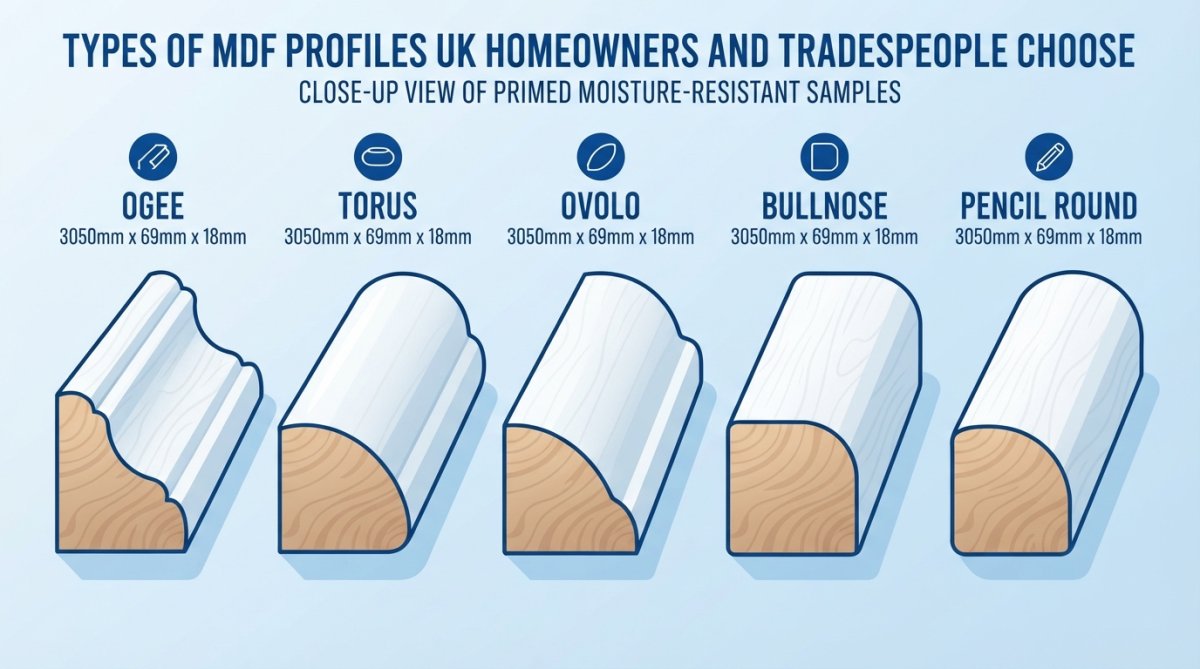
Ogee profiles feature an S-shaped curve that creates visual depth and elegance. The concave-convex design works exceptionally well in period properties, Victorian conversions, and high-end modern homes. The [Ogee MDF Moisture-Resistant Architrave](https://17e3mw-ix.myshopify.com/products/ogee-mdf-primed-architrave) at 69mm width is particularly popular for doorways where you want presence without overwhelming the opening.
Torus profiles present a fully rounded, bulbous edge like a half-cylinder. This classic profile suits both traditional and contemporary spaces. The rounded shape is forgiving during installation because slight misalignment doesn't create visible gaps, and it's durable because there are no sharp edges to chip. The Torus MDF Moisture-Resistant Skirting Board at 144mm height provides substantial visual weight at floor level.
Ovolo profiles offer a gentler curve than Torus, a quarter-circle edge rather than a full semicircle. This creates softer architectural detail, working well in transitional spaces where you want character without boldness. The Ovolo MDF Moisture-Resistant Skirting Board balances presence and subtlety effectively.
Bullnose profiles feature a fully rounded top edge with a flat face. This profile is nearly universal because it works in period properties, modern spaces, and everything between. The Bullnose MDF Moisture-Resistant Skirting Board is the safest choice when unsure and most forgiving to install.
Pencil Round profiles are the most subtle, just a gentle roundover on an otherwise simple rectangular profile. This minimalist approach suits contemporary properties. The Pencil Round MDF Moisture-Resistant Skirting Board is popular with architects designing modern renovations.
| Profile Type | Best For | Visual Character | Difficulty to Install |
|---|---|---|---|
| Ogee | Period properties, high-end details | Elegant, dimensional | Moderate |
| Torus | Traditional and contemporary | Bold, substantial | Easy |
| Ovolo | Transitional spaces | Subtle, refined | Easy |
| Bullnose | Universal application | Balanced, safe | Very Easy |
| Pencil Round | Modern, minimalist | Understated, clean | Very Easy |
Matching profiles to your property type matters more than chasing the "best" profile. A bold Torus skirting in a 1920s semi-detached house looks out of place. The profile should feel like it belongs to the building's era and aesthetic language.
MDF vs Solid Wood Profiles UK: Durability and Value
Moisture-resistant MDF often outperforms solid timber in UK renovations. Solid wood moves with moisture content, when humidity rises, wood fibres swell; when it drops, they shrink. This creates visible problems: gaps appear at joints, paint cracks along grain lines, and warping becomes visible within months in high-moisture areas.
Moisture-resistant MDF is engineered to minimize movement. The resin-bonded construction locks wood fibres in place, preventing the seasonal expansion and contraction that destroys solid wood. In bathrooms and kitchens, MDF simply performs better.
Durability also depends on finish quality. Solid wood requires regular maintenance: sanding, refinishing, and resealing every 3-5 years. Primed MDF requires paint and occasional touch-ups, but the substrate doesn't degrade. A well-painted MDF skirting board looks fresh for 7-10 years; solid wood in the same environment will show grain checking and surface degradation within 4-5 years.
Cost-effectiveness heavily favours MDF. Solid hardwood skirting costs 3-4 times more than quality moisture-resistant MDF, and that premium doesn't translate to better performance in renovation contexts. For a 100-metre renovation, that's a difference of £1,500-2,000 that goes toward better installation, better paint, or contingency budget.
Installing MDF Profiles UK: Step-by-Step for Professional Results
Installation quality determines whether your material investment delivers the finished appearance you've paid for.
Surface preparation is non-negotiable. Use a straightedge to identify high and low spots. Fill depressions with flexible filler, sand high spots with 80-grit paper until the wall is reasonably flat. Dust everything thoroughly. MDF adhesive and fixings work best on clean surfaces.
Primed profiles save time on site. Manufacturing skirtings and architraves in Hampshire, suppliers like Univers provide primed boards ready to install and paint. This eliminates the sanding step that unprimed boards require. Install the primed board, fill nail holes and joints with flexible filler, sand lightly with 120-grit paper, and paint. This workflow takes 40% less time than priming and sanding unprimed stock.
Fixing method matters for durability. Use a combination of adhesive and mechanical fixings. Apply flexible construction adhesive to the back of the profile in a continuous bead, then drive stainless steel or coated fixings every 400-500mm. The adhesive does most of the work; fixings are insurance against seasonal movement.
Joints require planning. Wherever possible, plan profiles to run full-length without joints. When joints are unavoidable, cut them at 45-degree angles (mitered joints) rather than square cuts. Mitered joints are less visible and perform better under seasonal movement. Fill mitered joints with flexible filler that moves with the material.
Finishing determines visual quality. After installation, fill all nail holes and joints with flexible filler. Let it cure fully, then sand with 120-grit paper. Prime any exposed MDF, then apply two coats of quality paint. Quality matters here; cheap paint peels while quality paint bonds to the primed MDF and flexes slightly with seasonal movement.
Maintenance and Repair: Keeping Durable MDF Profiles Looking New
Moisture-resistant MDF is durable but requires regular care to prevent minor issues from becoming visible problems.
Cleaning is straightforward. Dust regularly with a soft cloth. In kitchens and bathrooms, wipe down monthly with a damp cloth to remove moisture and residue. Avoid soaking the profile; dry it immediately after wet cleaning. This routine prevents grime buildup that makes profiles look tired.
Paint touch-ups prevent deterioration. When paint chips expose MDF, moisture can penetrate the substrate. Keep leftover paint from your installation and touch up damage within days of noticing it. A small bottle of touch-up paint costs £3-5 and prevents £300+ in repair costs.
Moisture damage requires early intervention. If you notice soft spots, swelling, or discolouration, the MDF has absorbed moisture. In early stages, dry the area aggressively and reseal with paint. If damage is extensive, more than 10% of the board's surface, replacement is more cost-effective than repair.
Minor damage repair is quick. Dents and dings in the paint are cosmetic. Sand lightly, fill with flexible filler, sand again, and touch up with paint. This takes 30 minutes and costs nothing. Most repairs are DIY-friendly and cost under £10 in materials.
Environmental Impact and Sustainability of MDF for Renovations
MDF is manufactured from wood fibres, waste from timber mills and sawmills, that would otherwise be burned or landfilled. This gives waste material a second life, which is environmentally positive. However, the binding resins and manufacturing process consume energy.
Responsible sourcing matters. Quality MDF manufacturers source wood fibres from sustainably managed forests and certified suppliers. Check your supplier's sourcing practices; it's a meaningful differentiator between manufacturers.
The lifecycle comparison is important. A moisture-resistant MDF profile that lasts 10 years requires less replacement and generates less waste than solid wood that requires refinishing every 3-5 years. Over a 20-year period, MDF often has a lower total environmental impact because you're replacing it less frequently.
Selecting the Right Durable MDF Profile for Your Renovation Project
Choosing the correct profile combines aesthetic judgment with practical constraints.
Start with the building's era and style. Victorian homes typically feature Ogee or Torus profiles; they're bolder and more ornamental. Edwardian and 1920s properties work with Bullnose or Ovolo, slightly more restrained. Post-war properties suit Bullnose, Ovolo, or Pencil Round depending on the specific style. Modern renovations are most flexible.
Profile height matters as much as shape. Skirting boards at 144mm (standard) work in most homes. Taller properties with high ceilings benefit from 170mm or taller profiles; they're proportionally correct and visually substantial. Smaller rooms with lower ceilings work better with 119mm profiles. Architraves typically run 69-89mm depending on door size and room scale.
Finish options expand aesthetic possibilities. Primed profiles are painted after installation, giving you unlimited colour choice. Veneered MDF profiles, where a thin timber veneer is applied to the MDF substrate, offer wood grain appearance without solid wood's instability. Choose veneered profiles for high-end properties where solid wood appearance is expected; choose primed for everything else.
Made-to-order solutions solve custom requirements. Standard profiles come in fixed heights and widths. If your renovation requires 160mm skirting or an unusual profile shape, made-to-order is available. Suppliers specialising in manufacturing skirtings and architraves in Hampshire and across the UK offer made-to-order solutions for profiles, heights, and finishes. This flexibility costs more and requires longer lead times (typically 2-3 weeks), but it solves problems that standard stock can't address.
| Property Type | Recommended Profile | Height | Finish | Why It Works |
|---|---|---|---|---|
| Victorian/Edwardian | Ogee or Torus | 144mm | Primed | Matches period architectural language |
| 1920s-1950s | Bullnose or Ovolo | 144mm | Primed | Balances detail with restraint |
| Modern property | Pencil Round or Bullnose | 119-144mm | Primed | Minimal detail suits contemporary aesthetic |
| High-end renovation | Ogee or Torus | 170mm | Veneered | Substantial presence, authentic appearance |
| Budget-conscious | Bullnose | 144mm | Primed | Versatile, forgiving, cost-effective |
Practical constraints matter. If your renovation includes underfloor heating, ensure skirting profiles don't obstruct heat distribution. If you're working in a listed building, check conservation guidelines. If you're managing tight timelines, choose primed profiles; you save 2-3 days of on-site preparation. If you're managing costs, Bullnose primed profiles deliver professional results at the lowest price point.
Choosing durable MDF profiles for renovations means committing to materials that perform in British homes. The moisture-resistant resin-bonded construction, combined with proper installation and maintenance, delivers finishes that look intentional for a decade or more. At Univers Skirting & Architrave, we've supplied thousands of metres of primed, moisture-resistant profiles to tradespeople and homeowners across the UK. Our profiles arrive ready to install and paint, eliminating on-site preparation time and ensuring consistent quality. With free UK delivery on orders over £150 and made-to-order solutions for custom requirements, we help you achieve professional results without the complexity. Start your renovation with materials engineered to last, explore our moisture-resistant MDF range and see why thousands of UK professionals choose quality that performs.
Frequently Asked Questions
What makes MDF profiles durable for renovations in UK homes?
Durable MDF profiles are constructed from resin-bonded wood fibres that resist moisture, swelling, and warping, common issues in British climates. Moisture-resistant MDF uses specially formulated resin to protect against bathroom and kitchen humidity. Primed profiles arrive ready to paint, eliminating weak spots from bare wood exposure. Quality manufacturing ensures consistent density and strength, making them more stable than cheaper alternatives that may split or warp during installation or after exposure to temperature changes.
How does moisture-resistant MDF differ from standard MDF for UK renovations?
Moisture-resistant MDF incorporates water-resistant resin during manufacturing, creating a barrier against humidity and condensation. Standard MDF lacks this protection and can swell or warp when exposed to moisture in bathrooms, kitchens, or damp properties. For UK renovations, moisture-resistant profiles are essential in wet areas and older properties with poor ventilation. The investment in moisture-resistant options prevents costly repairs and ensures a durable finish that lasts years longer than unprotected alternatives.
What are the main profile types available, and which suits my renovation style?
Common profiles include Ogee (decorative curved), Torus (rounded bulge), Ovolo (gentle curves), Bullnose (fully rounded), and Pencil Round (slim and modern). Ogee and Torus suit period properties and high-end homes seeking traditional detail. Ovolo and Bullnose work for both Victorian conversions and modern properties. Pencil Round offers a contemporary, minimalist look. Choosing the right profile depends on your home's architectural style, wall detail requirements, and whether you're modernizing or preserving period features. Primed profiles in these styles are ready to paint in any colour.
Why should I choose MDF profiles over solid timber for my renovation?
MDF offers superior stability compared to solid wood, it won't split, warp, or shrink as timber does in fluctuating UK humidity. MDF profiles are more affordable while delivering a professional durable finish. They accept paint and stain evenly, creating a high-end appearance in modern and period properties alike. Solid timber requires more maintenance and skilled installation. For renovations on budget or timelines, machined MDF profiles, especially primed options, deliver consistent quality and faster installation without the durability compromises of cheaper wood alternatives.
How do I install MDF skirting boards and architraves for a professional finish?
Start with proper surface preparation, ensure walls are clean, dry, and level. Primed MDF profiles require minimal sanding before paint application, saving site time. Use appropriate adhesives and fixings designed for MDF, avoiding over-tightening which can damage the material. For skirting boards, maintain consistent gaps at corners and use quality joint compounds for seamless finishes. Architraves should be mitred at angles for a built-in appearance. After installation, a second coat of quality paint provides a durable, professional-looking finish. Professional installers report faster project completion with primed, moisture-resistant MDF versus unfinished timber.
What maintenance do durable MDF profiles need to stay in good condition?
Regular dusting and occasional damp-cloth cleaning keep MDF profiles looking new. Avoid prolonged moisture exposure, wipe spills promptly in kitchens and bathrooms. Touch up paint scuffs or damage immediately to prevent moisture penetration. Inspect profiles annually for signs of swelling or warping, particularly in high-humidity areas. Quality paint finishes provide the main protection layer, so maintaining the paint coat is essential. With proper care and moisture-resistant construction, MDF profiles easily outlast cheaper alternatives and require far less maintenance than solid timber, which needs periodic refinishing.
Are MDF profiles environmentally sustainable for renovations?
MDF is manufactured from wood fibres and recycled timber, making it a more sustainable choice than solid hardwood, which requires harvesting mature trees. The manufacturing process uses these waste materials efficiently, reducing environmental impact. Responsible manufacturers source materials responsibly and use formaldehyde-free or low-emission resins. Durable MDF profiles that last decades reduce the need for replacement and associated waste. For environmentally conscious renovations, MDF offers a balance between durability, affordability, and sustainability, particularly when sourced from UK manufacturers committed to responsible practices.
This article was written using GrandRanker